Cloquet Fire 1918: Minnesota's Deadliest Day
- Cloquet, Moose Lake, and Duluth, Minnesota, 1918
- 12 min film
- Published
Liked it? There’s a new story every week.
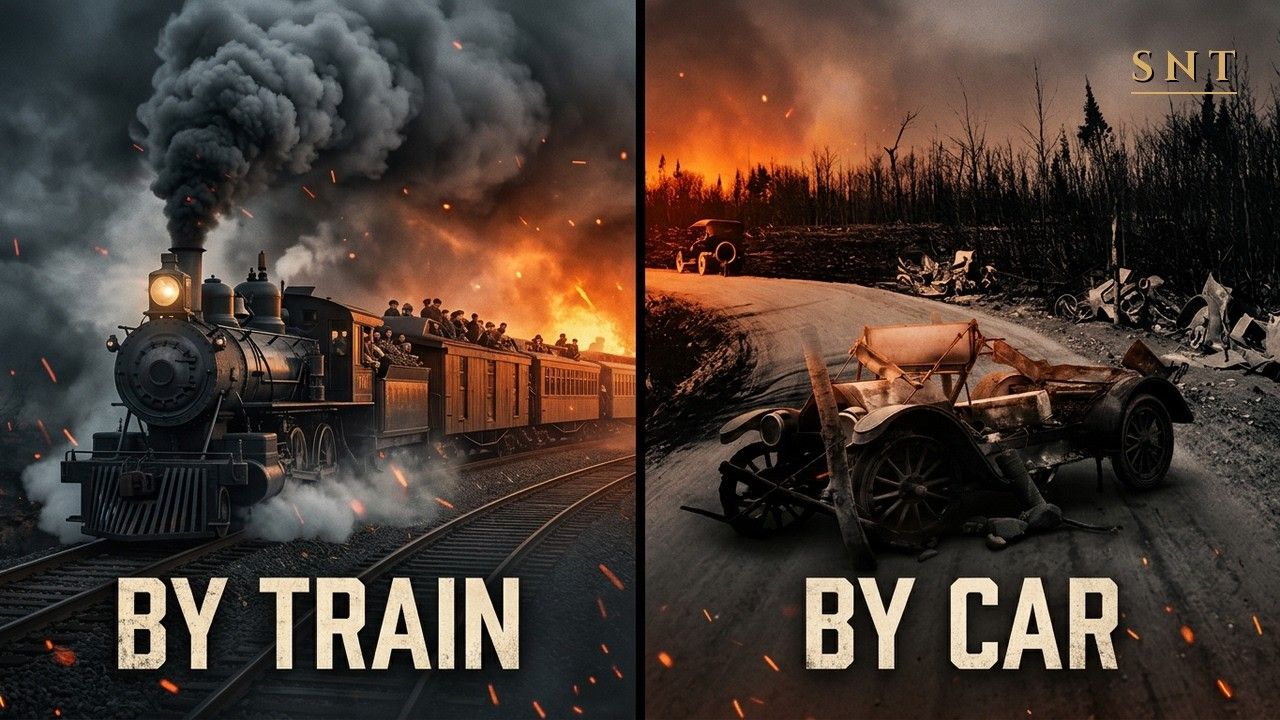
On a Saturday night in October 1918, four trains pulled out of Cloquet, Minnesota. Behind them, a lumber town of more than 7,000 people was about to vanish. The last train left with the fire at its back. By dawn, Cloquet was almost gone. Only five people there were dead.
A few miles to the south, on a sharp bend in a dirt road later called Dead Man’s Curve, people who tried to outrun the same fire in automobiles were not as lucky. Historians later estimated that 75 to 100 people died at that curve alone. The deadliest day in Minnesota history lasted less than 15 hours and killed 453 people. Because it happened in the same month as the worst wave of the influenza pandemic, and only 30 days before the end of the First World War, much of the country barely looked up.
Drought in northeastern Minnesota, 1918
In 1918, northeastern Minnesota was timber country. Logging had stripped the forests and left the ground littered with slash — the tops, branches, and waste no mill wanted. Lumberyards held mountains of drying boards. In Cloquet, three sawmills stood among streets of frame houses. Farmers burned brush and fields, as they always had, and locomotives, against the law, still threw sparks. After two years of unusual drought over the Arrowhead, the summer and fall had been extremely dry. Small fires were common.
Kathryn Elfes Gray, who lived through that Saturday, later said forest fires were an old story. “The increasing smokiness and rising wind all afternoon, with the sun like a red ball in the murky sky, hadn’t frightened me.”
Railroad fires and the wind on October 12, 1918
The Cloquet Fire was not one fire, but 50 or more, lifted into a single disaster. H. W. Richardson, of the U.S. Weather Bureau office in Duluth, later wrote that 50 to 75 or more fires had come together that day.
On October 4, sparks from a train ignited a small fire along the tracks near Tamarack, in Aitkin County. It smoldered for more than a week. On October 10, a Great Northern locomotive started another fire at Milepost 62, northwest of Cloquet, near Brookston. Then, on Saturday, October 12, a cold front swept in from the northwest. The humidity dropped, the wind rose, and around 1:30 in the afternoon both fires began to move.
Later accounts put the wind at 60 miles an hour, and then higher. A chronology compiled by the Minnesota Historical Society says that by 4 o’clock the winds exceeded 75 miles an hour. The fire’s front was reported as much as 10 miles wide, moving at up to 20 miles an hour. Survivors described walls of flame hundreds of feet high and a roar louder than thunder. In Duluth, smoke turned the afternoon so dark that the street lights came on.
Around 2 o’clock, the fire destroyed the village of Brookston. Around 3:30, a woman named Laura Miettunen was thrown from a fleeing car near Brookston. Her body was never found.
Dead Man’s Curve near Kettle River and Moose Lake
South and west of Cloquet, a second fire was already running. The Moose Lake fire — at least five fires joined together — drove toward Automba, Kettle River, and Moose Lake. In Automba, 25 people were killed as the flames erased the village. The fire reached Kettle River around a quarter to 7. South of town, a dirt road made a sharp turn. In the smoke, automobiles piled up. The place would be called Dead Man’s Curve.
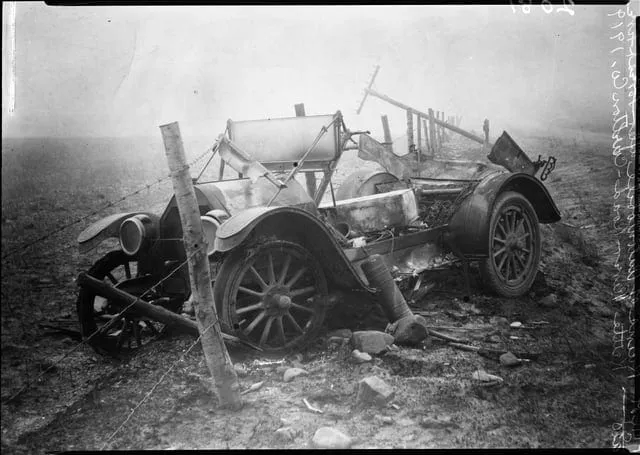
Ruins of a car after the fire, Kettle River Road, 1918. Minnesota Historical Society, via MNopedia.
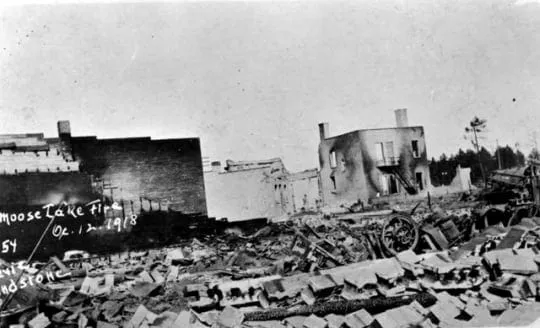
Street view after the fire, Moose Lake, 1918. Minnesota Historical Society, via MNopedia.
People could not outrun what was coming. Some escaped into streams, ditches, and open fields. Others hid in root cellars and died there of suffocation. As the blaze neared Moose Lake around 7:30, relief trains got a few hundred people out. Most of those who lived went into Moose Head Lake, and some drove their cars straight into the water and waited. By 10 o’clock the fire had passed. It had burned more than 400 square miles and caused more than half of that day’s deaths.
The evacuation trains out of Cloquet
Cloquet had something the smaller towns did not: a little time, and a railroad. Factory whistles blew, the fire department sent runners, and telephone operators called every number they could. The mayor organized four evacuation trains.
The fire reached the Fond du Lac Ojibwe reservation around a quarter past 7, and Cloquet around 8. The trains got out. Over 7,000 people left by rail, most of them toward Duluth and Superior, Wisconsin. Later counts put about 4,700 Cloquet residents in those two cities alone. Flames chased the last relief train out of town at 10 o’clock. The city burned almost flat. Only five people died there. A warning, a telephone system, and four trains had made the difference.
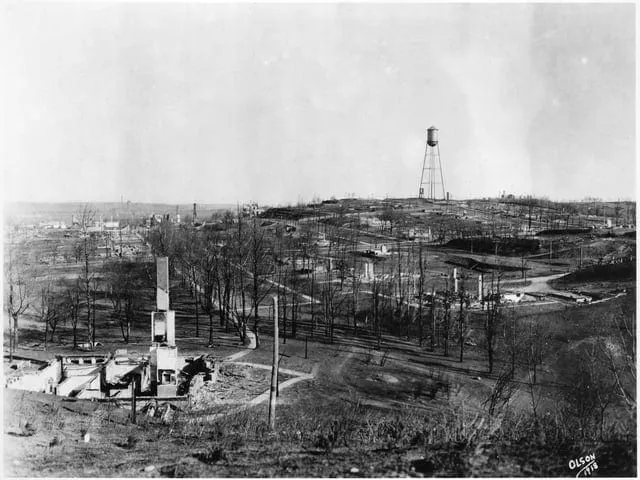
View of Cloquet after the fire, 1918. Minnesota Historical Society, via MNopedia.
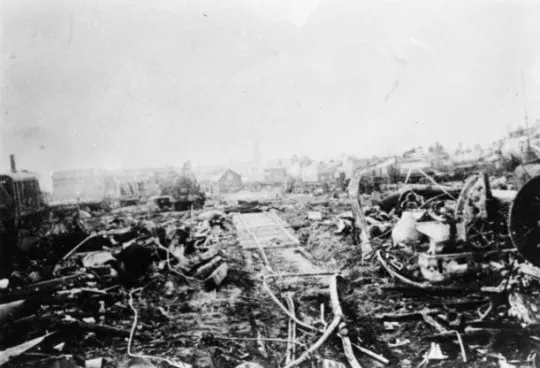
Duluth & Northeastern Railroad yards after the fire, 1918. Minnesota Historical Society, via MNopedia.
The fire at the edge of Duluth
The other arm of the fire ran east, toward Duluth. It reached the northeastern corner of the city around 7 in the evening, burned a country club and a train depot, and did not descend into the main part of Duluth. The winds began to fall around 9, and by 3 in the morning on Sunday, October 13, the fires had reached their limit at Lake Superior.
About 800 square miles had been charred on the Cloquet–Duluth side alone; later historical accounts put the total burned area at about 1,500 square miles. More than 35 communities were burned. Some — Cloquet, Brookston, Moose Lake — were almost completely destroyed. More than 52,000 people were affected.
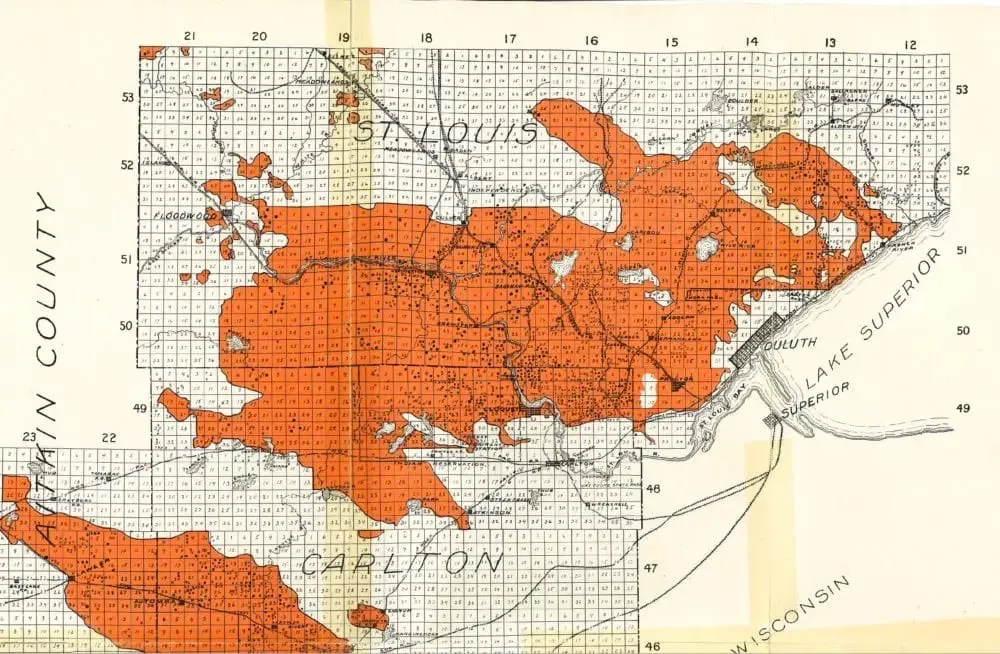
Walter I. Fisher, 1919 map of the fires' extent. Public domain, via Wikimedia Commons.
The official death toll, 453, comes from the state’s Forest Fires Relief Commission and is still the figure used by the Minnesota Historical Society. It made October 12, 1918, the deadliest single day of natural disaster in the history of the state. In the first days, no one knew the number. On October 14, the Bemidji Daily Pioneer ran a front-page headline claiming that over 600 bodies, by estimate, had been recovered. Other papers said at least 1,000 were dead.
Relief after the Cloquet Fire
On October 13, a statewide relief effort began, including the Minnesota Home Guard, the National Guard, the Motor Corps, the Red Cross, and other groups. Thousands of people from Cloquet took refuge in Duluth and in Superior, Wisconsin. The Red Cross served meals and put up temporary houses. The National Guard issued clothing. Governor J. A. A. Burnquist went north. On October 16, the Minnesota Commission of Public Safety met at Moose Lake and created the Minnesota Forest Fires Relief Commission. On October 19, heavy rain finally fell.
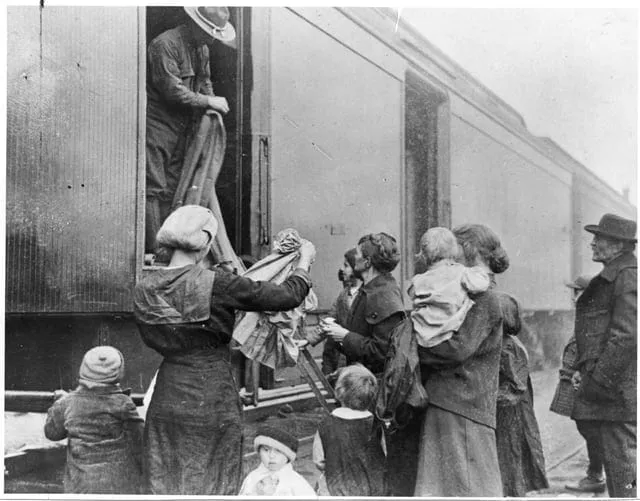
National Guard giving out clothing to refugees, 1918. Minnesota Historical Society, via MNopedia.
Influenza, the First World War, and the Cloquet Fire
The influenza pandemic was already in Minnesota. The first case in the state had been reported at the end of September, in a soldier home on leave. Duluth was among the first cities to close theaters and tell people to stay home, and then the fire sent thousands of refugees into that same city. Officials across the state shut schools, churches, theaters, and lodge halls.
The Minnesota State Board of Health later counted 2,105 influenza deaths in October and 3,260 in November — November was worse — and 7,521 in the state for the year 1918. About a third of Minnesota’s doctors were away at the war; others had gone north to treat fire victims. Fire survivors, already hurt and full of smoke, were packed into makeshift shelters, and influenza followed them. How many refugees later died of the flu is not known with precision. On November 11, 1918 — 30 days after the fire — the Armistice stopped the fighting in Europe.
Who started the Cloquet Fire of 1918
In the first days, rumors spread that enemy agents had set the woods on fire. Cloquet’s fire chief, F. J. Longren, later said those rumors were false. Locomotives had started the fires that would not stay small. Drought, slash, lumber piles, and a sudden wind did the rest.
Survivors sued the railroad companies. Cases reached the Minnesota Supreme Court in 1920 and 1921, including Anderson v. Minneapolis, St. Paul and Sault Ste. Marie Railway and Borsheim v. Great Northern. The legal fight was not finished until August 27, 1935, when President Franklin Roosevelt authorized large payments from the railroads — 17 years after the night itself.
On October 12, 1918, in less than 15 hours, a cluster of railroad fires killed 453 people and wiped whole towns off the map. In Cloquet, a warning and four trains saved thousands. On a curve in the road south of Kettle River, a traffic jam in the smoke did not. Drive through Cloquet today, and you would not know, unless someone told you, that the town once disappeared in a single night.
From the archive Sources
- Paul Nelson, "Cloquet, Duluth, and Moose Lake Fires, 1918," MNopedia, Minnesota Historical Society.
- Minnesota Digital Library, "The Fires of 1918."
- H. W. Richardson, "The Northeastern Minnesota Forest Fires of October 12, 1918," Geographical Review, April 1919.
- Minnesota Forest Fires Relief Commission, Final Report (1921).
- Francis M. Carroll and Franklin R. Raiter, The Fires of Autumn (Minnesota Historical Society Press, 1990).
- Mary Laine, "Influenza Epidemic in Minnesota, 1918," MNopedia.
- Bemidji Daily Pioneer, October 14, 1918.
- White Earth Tomahawk, October 24, 1918.
- Cook County News-Herald (Grand Marais), November 13, 1918.
- Bemidji Daily Pioneer, November 11, 1918.
More stories like this

1913·Marquette, Michigan
He Gets Drunk Too: Theodore Roosevelt's 1913 Libel Trial
1912·New York and Philadelphia
Ty Cobb Beat a Man in the Stands. Then His Whole Team Went on Strike (1912)
1916–1939·San Francisco, California
The Photograph That Couldn't Save Tom Mooney (1916)
1904·Cleveland and Oberlin, Ohio
Cassie Chadwick: The Woman Who Posed as Carnegie's Daughter
1899·Kansas City, Missouri
Jesse James' Son Was Tried for Robbing a Train. His Grandmother Was the Alibi (1899)
1922·Denver, Colorado