The Photograph That Couldn't Save Tom Mooney
- San Francisco, California, 1916–1939
- 13 min film
- Published
Liked it? There’s a new story every week.
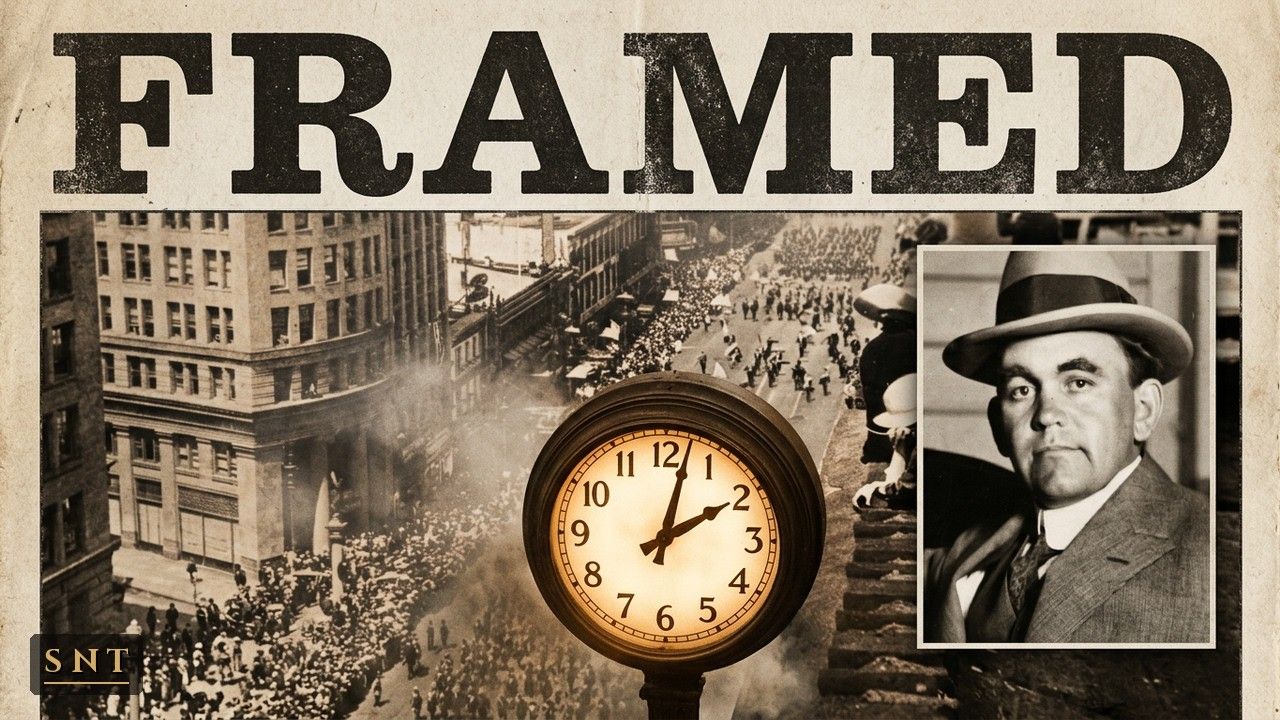
At six minutes past two on a Saturday afternoon in July 1916, a bomb hidden in a suitcase exploded on a crowded San Francisco sidewalk. Ten people died. Within a week, the police had their man. His name was Tom Mooney, and he was sentenced to hang.
But in the minutes before that bomb went off, a camera caught him standing on a rooftop, more than a mile away. The jury saw the photographs. They convicted him anyway. It would take a president, a new governor, and 22 years to get him out.
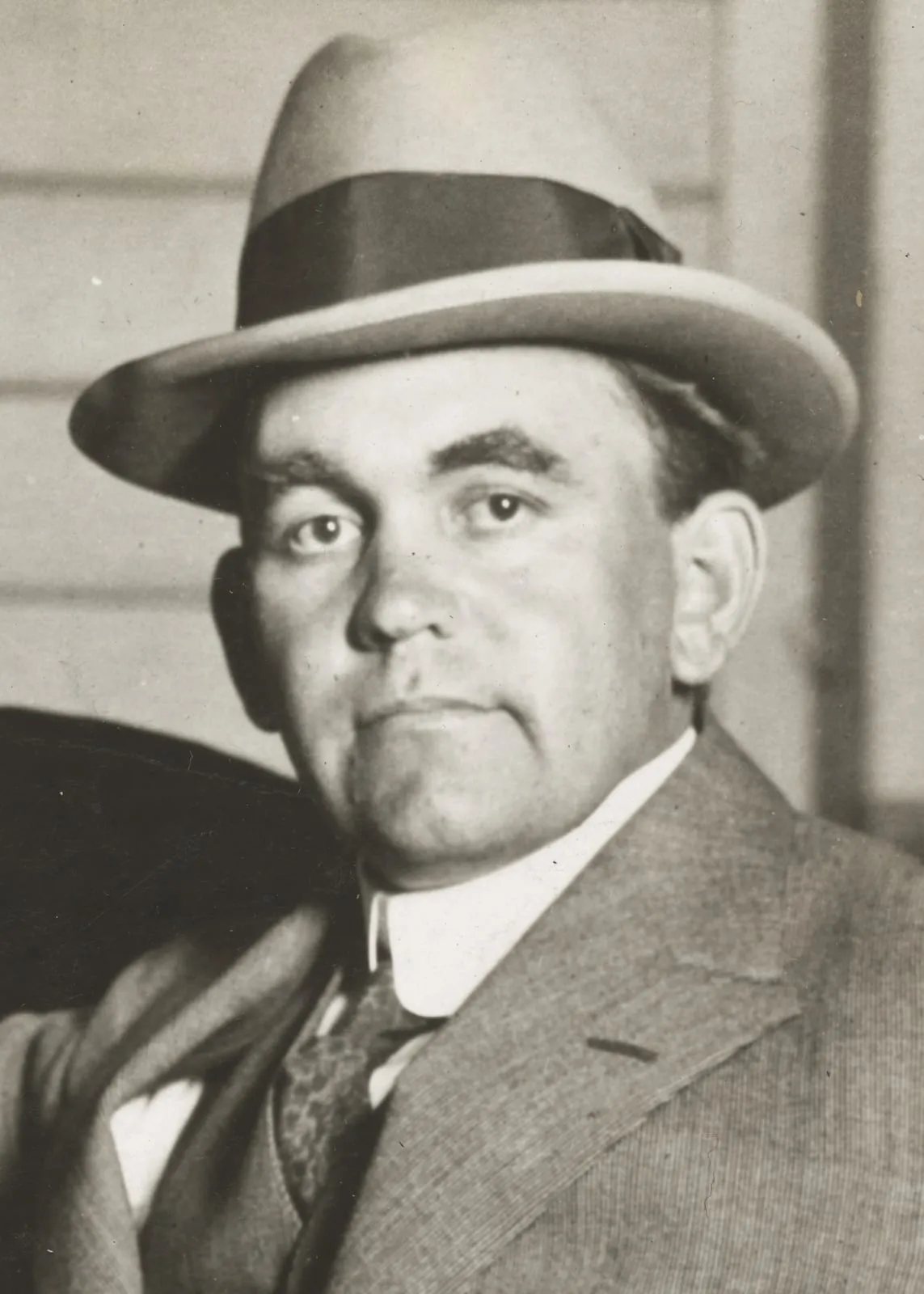
Tom Mooney, July 1916. Public domain, via Wikimedia Commons.
San Francisco and the Preparedness Day parade, July 22, 1916
In the summer of 1916, America had not yet entered the war in Europe. A movement called Preparedness wanted the country armed and ready, and San Francisco’s Chamber of Commerce organized a parade for Saturday, July 22. More than 51,000 people would march. Before the parade began, the city’s newspaper offices received a warning. It said, “we are going to use a little direct action on the twenty-second which will echo around the earth.” It ended, “Don’t take this as a joke or you will be rudely awakened.”
2:06 p.m. at Steuart and Market Streets
The parade had been moving for about half an hour. At Steuart and Market Streets, two blocks from the Ferry Building, a suitcase stood against the wall of a small brick building. At 2:06 it exploded. Inside was a dynamite bomb, set off by a clockwork timer. One Washington paper wrote that “The blare of fifty bands and the roar of drums drowned the cries of the injured.” Ten people were killed, and 40 or more were injured.
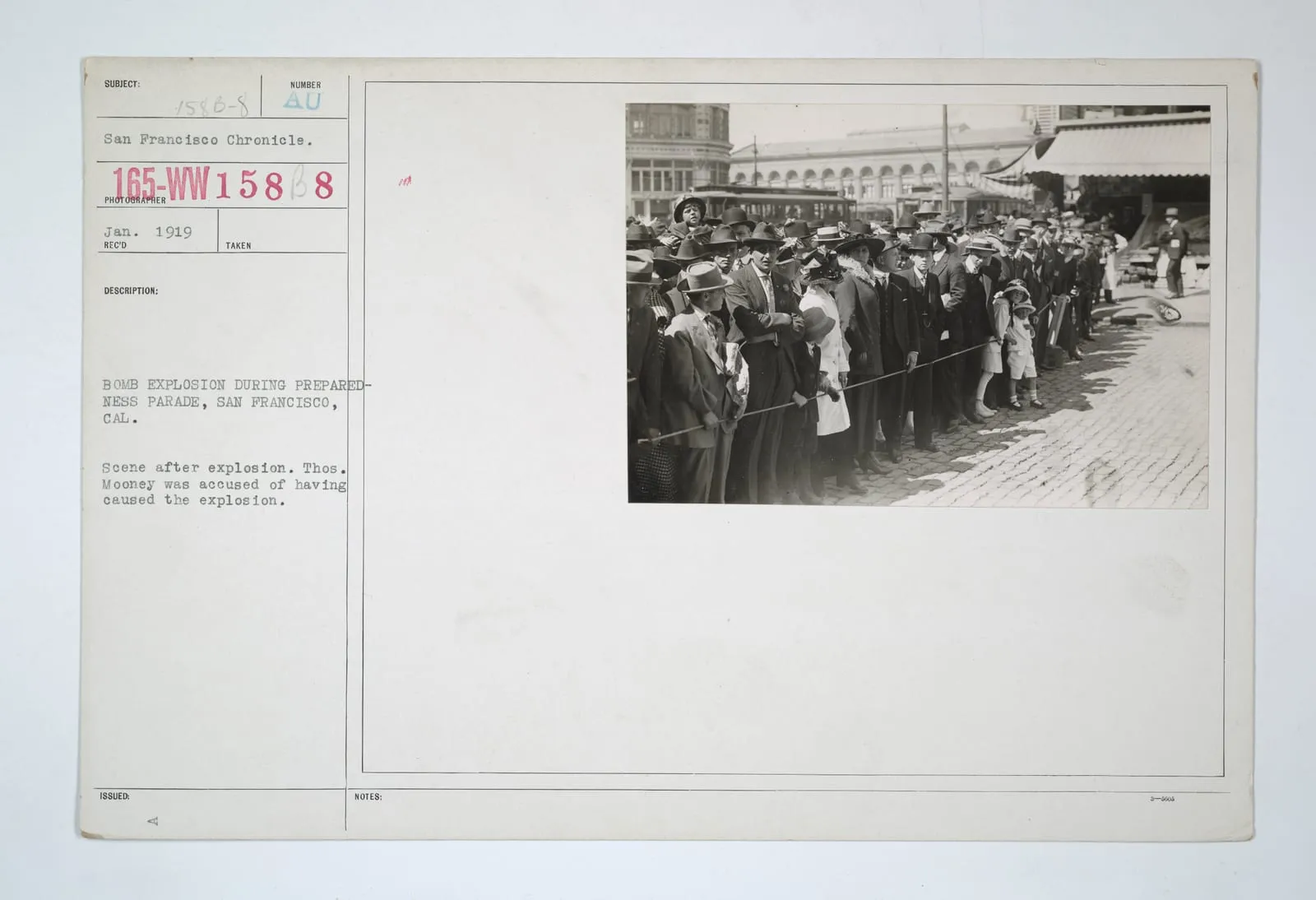
Scene after the explosion, Preparedness Day parade, San Francisco, July 22, 1916. U.S. National Archives, via Wikimedia Commons.
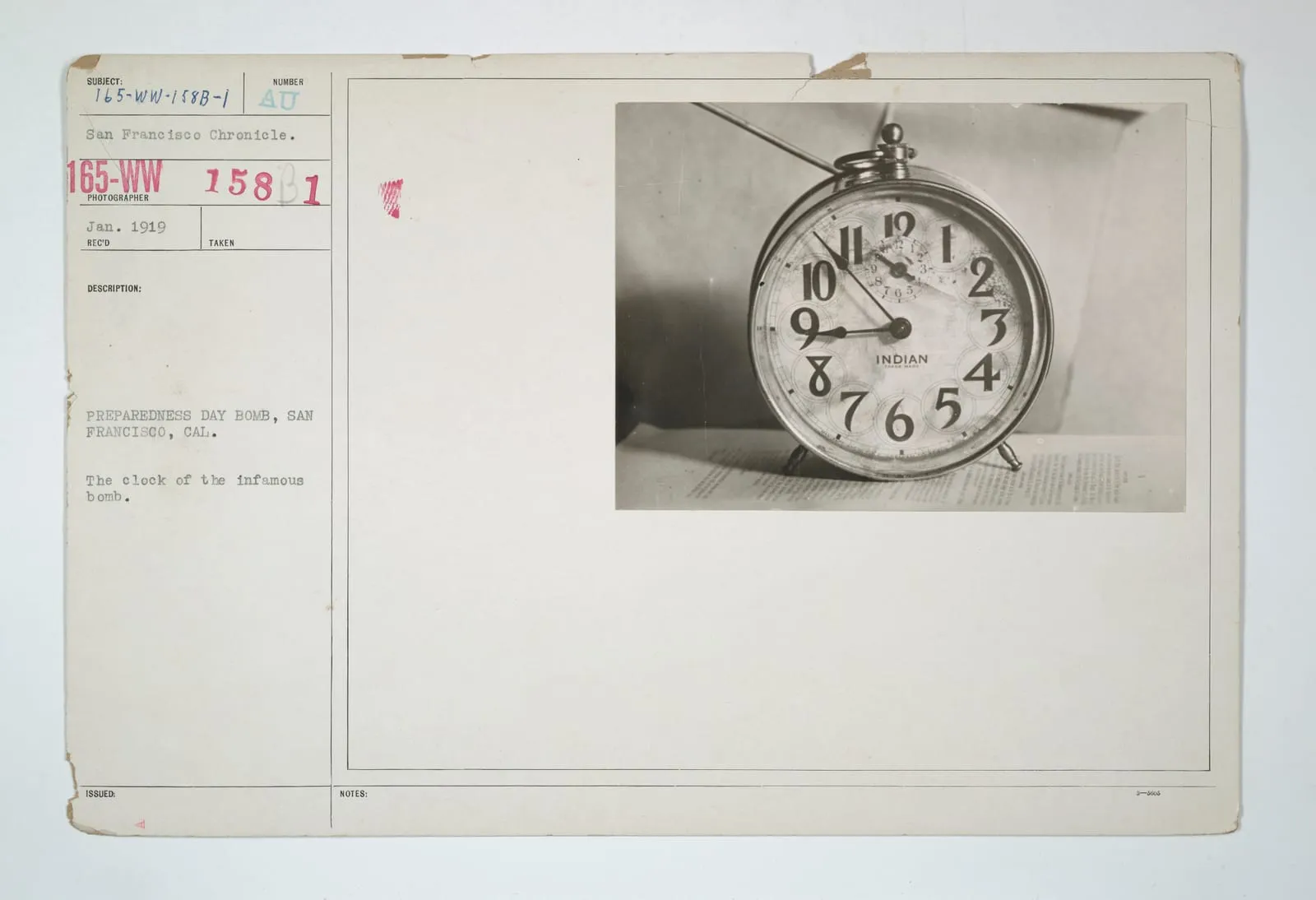
The clock from the bomb, Preparedness Day, San Francisco, 1916. U.S. National Archives, via Wikimedia Commons.
The usual suspects
The investigation was run by District Attorney Charles Fickert and Martin Swanson, a private detective who had worked for the city’s utility companies. Swanson had already tried to convict two local labor radicals. One was Tom Mooney, 33, a molder born in Chicago and a militant socialist, accused but never convicted in an earlier dynamite case during a Pacific Gas and Electric Company strike. The other was Warren Billings, Mooney’s 23-year-old assistant, who had already served a year for possessing dynamite during that same strike.
Billings was arrested on July 26. Tom Mooney and his wife, Rena, were arrested the next day. Police searched their homes without warrants and held them without lawyers. In early August, a grand jury indicted five people for murder: Tom and Rena Mooney, Warren Billings, Israel Weinberg, and Edward Nolan.
The witnesses
Billings was tried first, in September 1916. John MacDonald, a waiter, swore that he saw Billings set a suitcase down on Steuart Street, and that Mooney came out of a saloon to join him. MacDonald said it “must have been about two o’clock.” The jury convicted Billings and, after prosecutors did not ask for his death, he was sentenced to life in prison. Mooney’s trial began on January 3, 1917. MacDonald testified again, and this time put Billings at the corner at about a quarter to two.
The rooftop at 975 Market Street
Mooney said that he and Rena had watched the parade from the roof of the Eilers Music building, at 975 Market Street, more than a mile away. Wade Hamilton had taken three photographs from the roof next door, showing Tom and Rena Mooney on the Eilers roof, with a street clock in the frame. The times claimed for the photographs were 1:58, 2:02, and 2:04. The bomb went off at 2:06. But the bomb ran on a timer. To the prosecution, a man on a roof at 2 o’clock proved nothing if the suitcase had been set down earlier — and its key witness now said it had.
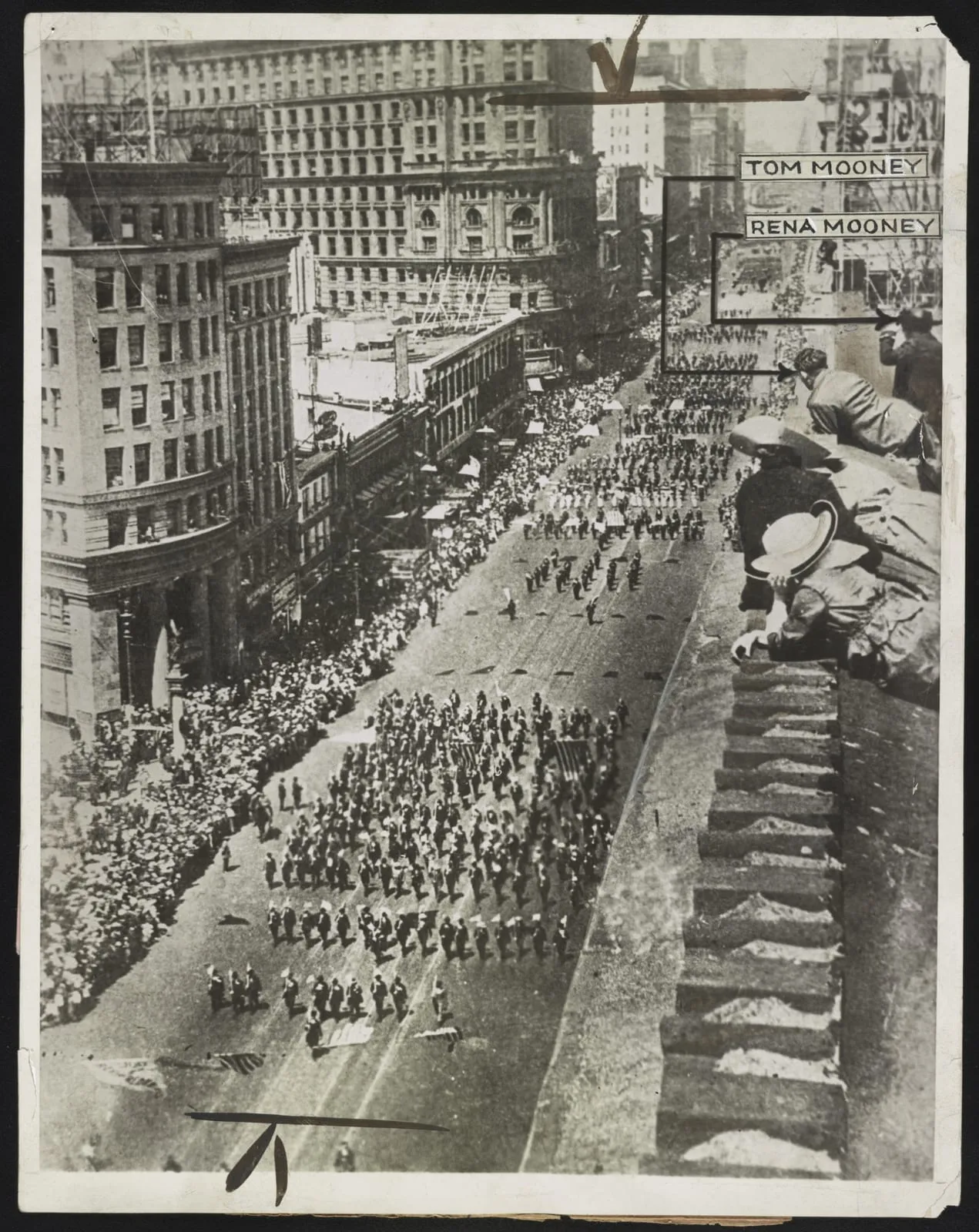
Market Street during the Preparedness Day parade, July 22, 1916, looking toward the Ferry Building. Period press labels in the print identify Tom Mooney and Rena Mooney on a rooftop. Library of Congress, Prints and Photographs Division, New York World-Telegram and the Sun Newspaper Photograph Collection. Photograph by Pacific & Atlantic Photos.
The prosecution then produced Frank Oxman, a cattleman from Durkee, Oregon. He swore he had been standing at Steuart and Market and had watched a car pull up, with Weinberg at the wheel, carrying Tom Mooney, Rena Mooney, Billings, and another man. He said Billings set a suitcase against the building, and he quoted Mooney: “Give it to him and let him go; we must get away from here; the bulls will be after us.” He produced an envelope with the car’s license number, Ford 5187. On February 9, 1917, after 13 trial days and 154 witnesses, the jury found Tom Mooney guilty of first-degree murder. On February 24, he was sentenced to hang.
The Oxman letters
That spring, letters surfaced. Before the trial, Oxman had written to Ed Rigall of Grayville, Illinois. The first one read, in Oxman’s own spelling, “I have a chance for you to cum to San Frico as a expurt wittness in a very important case.” “You will only hafto answer three and four questions and I will Post you on them.” “You will only hafto say you seen me on July twenty-second in San Frisco and that will Be Easy dun.” Rigall had not been in San Francisco that day. He came anyway, but never testified.
In April, Fremont Older’s San Francisco Bulletin made the letters public. Oxman was charged with trying to suborn perjury, tried, and acquitted. Judge Franklin Griffin called for a new trial, and the state’s attorney general agreed, but the state Supreme Court said it could not order one. In 1918 it held that “a judgment cannot be set aside because it is predicated upon perjured testimony.” Rena Mooney and Israel Weinberg were tried and acquitted. Edward Nolan was never tried. The two men tried first stayed convicted.
The world watches, 1918
The case had gone far beyond San Francisco. A 1918 report said news of it reached Petrograd in the early days of the Russian Revolution, where people demonstrated against Mooney’s execution. President Woodrow Wilson’s Mediation Commission found that the testimony of the state’s witnesses had changed from trial to trial, casting doubt on the verdicts. Wilson telegraphed Governor William Stephens asking for clemency. On November 28, 1918, two weeks before the hanging date, Stephens commuted Mooney’s sentence to life, citing “the urgent appeal of the President of the United States.”
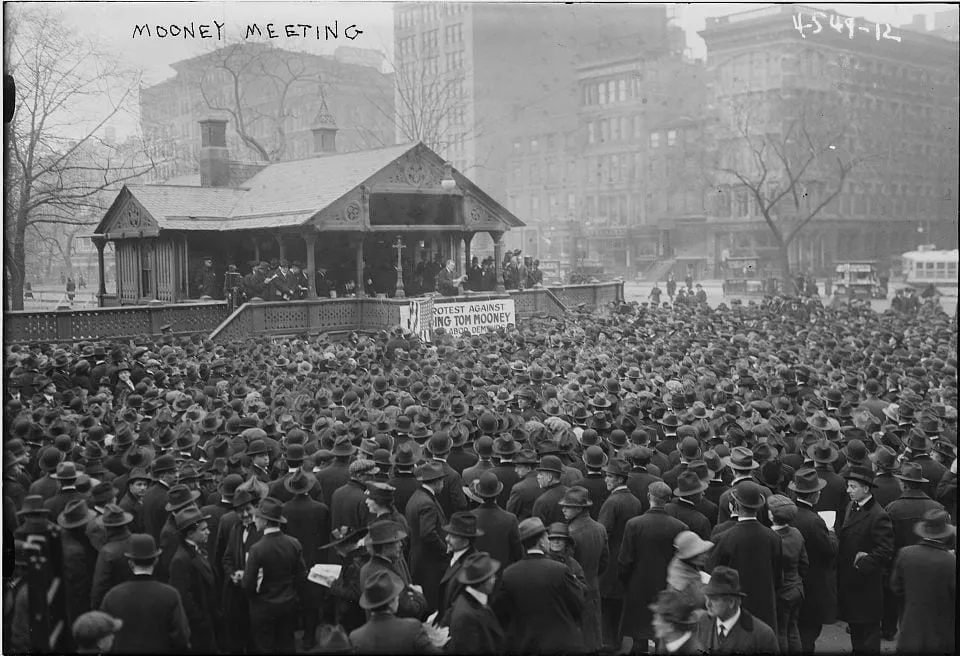
Thomas Mooney protest in Union Square, Manhattan, March 9, 1918. Bain News Service, via Wikimedia Commons (Library of Congress Bain Collection).
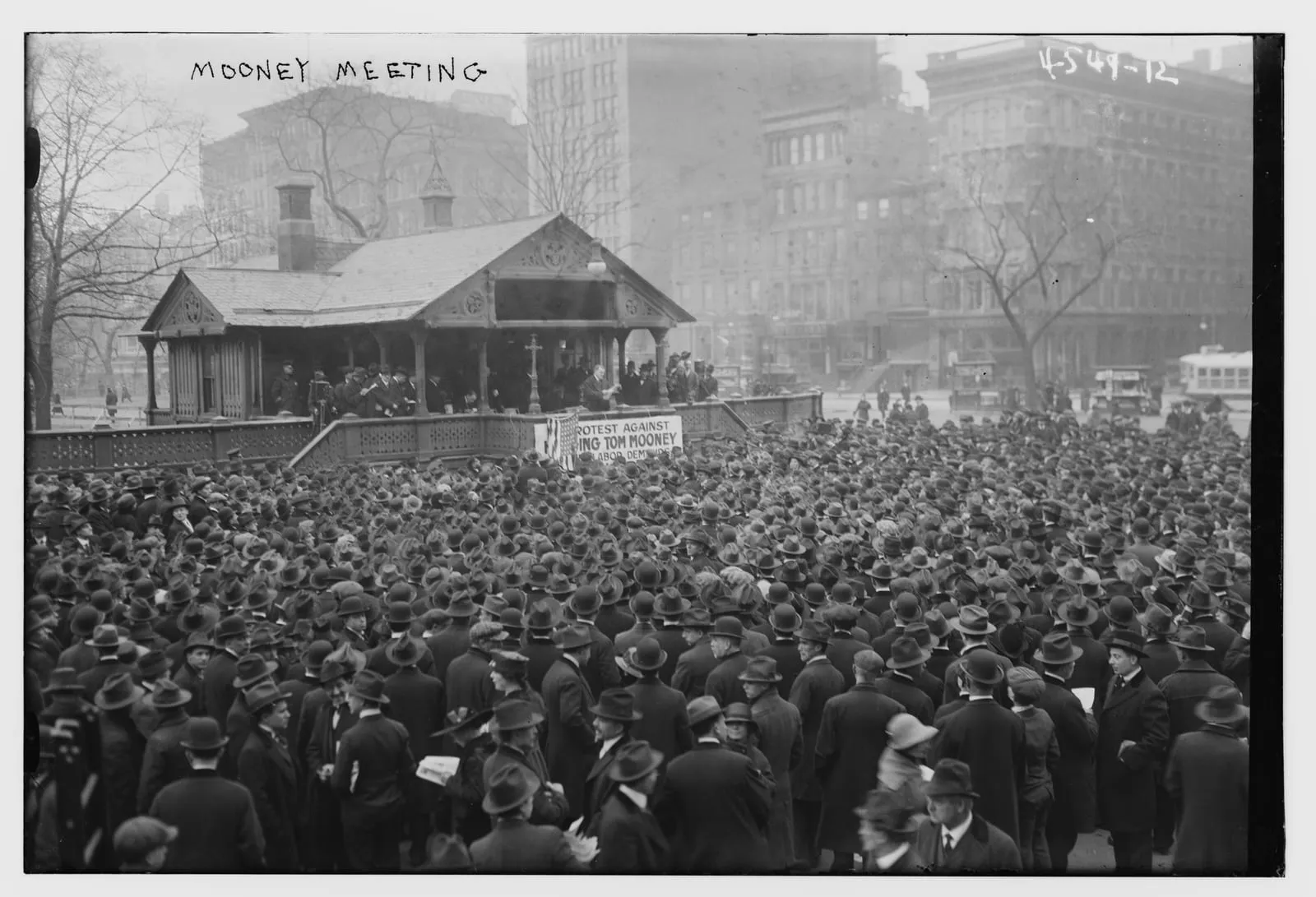
Mooney meeting, 1918. George Grantham Bain Collection, Library of Congress, via Wikimedia Commons.
Twenty years of no at San Quentin
At San Quentin, Mooney became prisoner number 31921. The next four governors of California all refused to pardon him. Mooney turned down a parole offer; he wanted a pardon or a new trial. In 1921, John MacDonald signed an affidavit taking back his testimony.
In 1931, investigators for President Herbert Hoover’s Wickersham Commission finished a report on the case. The commission refused to issue it, and it was published privately in 1932. “Witnesses were coached in their testimony to a degree that approximated subornation of perjury.”
The chief justice of California asked astronomers W. F. Meyer and C. D. Shane whether they could tell the time from the rooftop photographs. The original films were lost, and the street clocks could not be read, but shadows from flags over Market Street gave about 2:01, 2:05, and 2:06 and a half. The bomb exploded at 2:06. If they were right, the last picture was taken at about the moment of the blast, with Mooney on a roof more than a mile away.
In 1935, the United States Supreme Court said a state could not convict a man through “the presentation of testimony known to be perjured,” but sent Mooney back to the California courts. In 1937, the California Supreme Court ruled that he had not proved his case.
The 1939 pardon of Tom Mooney
In January 1939, California swore in a new governor, Culbert Olson. Five days later, on January 7, Olson had Mooney brought from San Quentin to the state Assembly in Sacramento, and pardoned him. The pardon read, “I have made an extended study of the voluminous records of this case and am convinced that Thomas J. Mooney is wholly innocent of the crime of murder for which he was convicted and that his conviction was based wholly on perjured testimony presented by representatives of the State of California.” Tom Mooney was 56.
Warren Billings had an earlier felony on his record, so his case needed the state Supreme Court’s consent. It allowed only a commutation, and he walked out in October 1939. He was not pardoned until 1961, and he died in 1972. He died in a San Francisco hospital on March 6, 1942.
In 1963, in Brady v. Maryland, the Supreme Court ruled that prosecutors who suppress evidence favorable to the accused violate due process. The Court wrote that its ruling was “an extension of Mooney v. Holohan.” Ten people died on Steuart Street. A photograph, and a handful of shadows, showed where Tom Mooney was that afternoon. And whoever left that suitcase against the wall was never found.
From the archive Sources
- People v. Mooney, 178 Cal. 525 (1918), Supreme Court of California.
- Mooney v. Holohan, 294 U.S. 103 (1935).
- In re Mooney, 10 Cal. 2d 1 (1937), Supreme Court of California.
- Brady v. Maryland, 373 U.S. 83 (1963).
- The Mooney-Billings Report, prepared for the National Commission on Law Observance and Enforcement (Wickersham Commission), 1931; published 1932.
- W. F. Meyer and C. D. Shane, "The Determination of Time from Shadows Shown on a Photograph," Publications of the Astronomical Society of the Pacific 48 (1936).
- Governor Culbert L. Olson, Full and Unconditional Pardon for Thomas J. Mooney, January 7, 1939.
- Northern District Historical Society, Preparedness Day Bombing program and chronology (2016).
- Newspapers: Evening Star (Washington), July 23, 1916; Fairmont West Virginian, July 27, 1916; Richmond Palladium, Feb. 10, 1917; Butte Daily Post, April 18, 1917; New-York Tribune, Nov. 29, 1918 (Chronicling America, Library of Congress). Morning Oregonian, March 30, 1918; Morning Register (Eugene), May 24, 1921 (Historic Oregon Newspapers, University of Oregon).
- Periodicals: International Socialist Review, May 1910; The Liberator, March 1918 (cartoon by Robert Minor); The Labor Defender, July 1928 and February 1929.
More stories like this
1913·Marquette, Michigan
He Gets Drunk Too: Theodore Roosevelt's 1913 Libel Trial
1899·Kansas City, Missouri
Jesse James' Son Was Tried for Robbing a Train. His Grandmother Was the Alibi (1899)
1905·Cheyenne, Wyoming
Buffalo Bill Sued His Wife, Saying She Poisoned Him (1905)
1893–1906·Fall River, Massachusetts
Lizzie Borden After the Acquittal: Accused Again in 1897
1918·Cloquet, Moose Lake, and Duluth, Minnesota
Cloquet Fire 1918: Minnesota's Deadliest Day
1912·New York and Philadelphia